




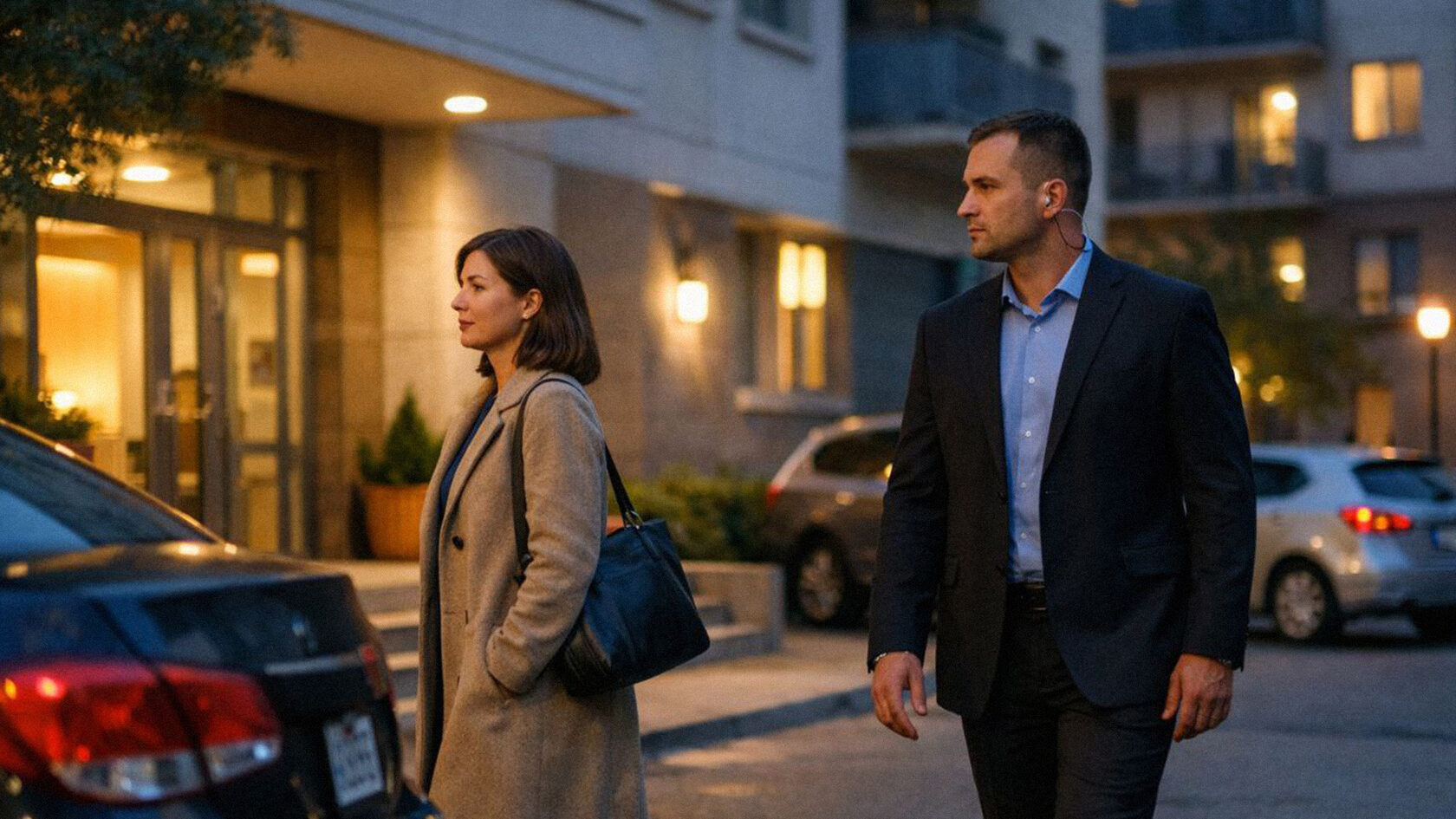
The moment a woman truly needs a bodyguard rarely looks like a movie scene. More often it is a very ordinary day that quietly stops being ordinary. The same car parked downstairs too often. Messages that feel less like “talk” and more like pressure. “Coincidental” meetings that happen a little too regularly. On paper, nothing dramatic has happened yet. In reality, it becomes harder and harder to live in that constant low‑grade fear.
In this world, personal protection is not about glamour. It is about the ability to reclaim basic ownership of your routine. Armada Security approaches this as a service: a bodyguard can be involved for a few hours, for a day, for a short but intense period. A woman does not have to see herself as a VIP to ask for help. She just has to admit an honest fact: “I no longer feel safe handling this alone.”
When “just a difficult person” becomes a real risk
On the surface, many of these stories look almost trivial. There is no headline crime, just a person who refuses to let go:
- an ex‑partner who won’t respect distance;
- someone who keeps demanding “one last conversation”;
- engineered encounters in the same places;
- attempts to monitor where she goes and who she meets.
At this stage, official mechanisms may respond slowly: the pressure is real, but not yet a criminal case. A bodyguard in such a context is not a vigilante. He is a line that cannot be crossed. With a professional present, the “difficult person” is no longer talking to a woman alone — he is speaking in front of someone trained to act if that line is crossed.
A living boundary, not a movie hero
A good bodyguard in an everyday conflict is, first and foremost, a boundary in human form. Not someone who “goes on the offensive,” but someone who doesn’t allow escalation to happen. His presence creates several layers of protection:
- physical: no one gets too close or blocks the way;
- spatial: the environment is constantly scanned for risk, and safer routes are chosen;
- emotional: she no longer has to hold the entire confrontation alone.
In many countries, private security companies are increasingly evaluated not only by their ability to react, but by their ability to de‑escalate — to keep conflict from turning into violence. In that sense, a bodyguard’s job is to make sure the worst‑case scenario never gets a chance to unfold.
Why hourly protection fits women’s real lives
For years, most women would have dismissed the idea of a bodyguard outright: too dramatic, too expensive, “not my world.” The hourly model changes that. Being able to hire protection from just one hour, without long contracts or heavy commitments, turns security into a flexible, realistic tool.
It makes sense when:
- there is one difficult meeting that needs to be handled calmly;
- an entire day is filled with tense interactions and it is better not to walk into them alone;
- a few evenings feel unsafe and taking that risk no longer seems reasonable.
In each of these situations, she is not buying an image. She is buying a window of safety — a few hours in which she can focus on the substance of what must be done instead of constantly scanning for danger.
Female bodyguards: different energy, same level of protection
One noticeable development in private security worldwide is the growing role of women in protection details. For many female clients, this is not a nuance, but a decisive factor. Standing next to another woman makes it easier to speak openly, to share context and to feel emotionally understood rather than judged.
From the outside, a female bodyguard can look like a colleague or a friend, which helps lower the visible tension around already difficult situations. At the same time, her training and responsibility are on par with any male colleague: she is just as capable of reading risk, structuring routes and stepping in if something goes wrong.
The right not to be heroic alone
At its core, a bodyguard in a domestic conflict represents one simple right: the right not to face everything alone. Not to prove to the world — or to yourself — that you can carry any amount of pressure without help. Not to accept dangerous meetings just to avoid being called “dramatic.”
The mission of a personal protection service here is straightforward: to give a woman the chance to move through a hard chapter of her life with support, not with raw nerves. If that requires just a few hours with a professional at her side, it may be one of the most rational investments she can make — not in status, but in her own freedom.