




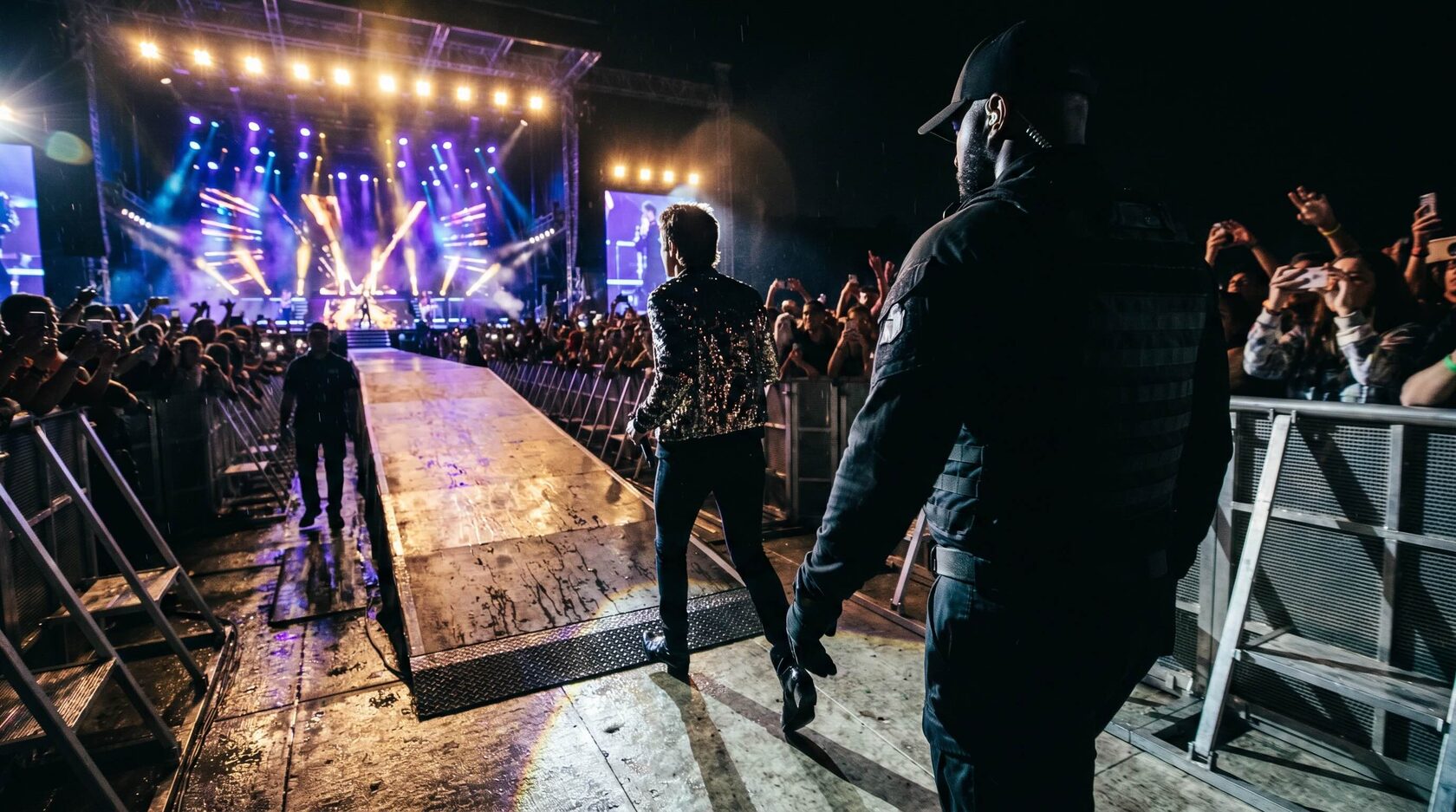
What happens backstage so the artist thinks about the audience — not who’s at the dressing‑room door
Big concerts and high‑profile premieres have an unspoken trait. For the audience it’s a celebration — lights, sound, emotion, the thrill of seeing someone live instead of on a screen. For the artist it’s a compressed, high‑pressure few hours: schedules down to the second, and the boundary between private space and strangers disappears. From the moment a car enters the venue to the moment it leaves, a complex logistics operation unfolds — and personal security plays a quiet but critical role.
Event security vs personal protection
Venue security handles the crowd: ticket checks, metal detectors, lines, capacity rules, evacuation routes. That’s essential, but it’s a mass layer. Armada operates on a different level — focused on the individual and their team: the person who steps on stage, receives applause, and at the same time becomes the most vulnerable figure at the event.
The artist is the event’s primary asset
For promoters a big show is budget, contracts, venue hire, production, marketing. For the audience it’s emotion and the chance to “see them live.” For the artist it’s creativity mixed with heavy operational load: sound, lights, setlist, team readiness, media obligations, sometimes live broadcasts. Often overlooked is a simple fact: the artist is both the main asset and a main source of risk if something goes wrong.
Risks start long before a fan jumps on stage
Risks aren’t limited to the clichéd “fan runs onto the stage.” They begin earlier: attempts to force backstage access, overzealous people at service entrances, uninvited guests in dressing rooms, surprise visits from acquaintances, aggressive fans who take refusal as insult. Venue security focuses on perimeter control. Armada’s personal protection addresses the other job — safeguarding one person from arrival until the last second on site.
Three concentric circles of artist protection
Experience shows effective protection at major events is layered.
- First circle — immediate proximity: dressing room, route to stage, backstage, the short distance from car to door. Here an Armada bodyguard is integral to the route. They know who belongs in the zone and who doesn’t; they spot someone trying to slip in with a group or seeking unwanted visual contact.
- Second circle — visible but not yet onstage: photo walls, press areas, VIP boxes, restricted fan zones. This layer protects both body and reputation — preventing an incident from becoming a viral clip. Armada guards de‑escalate so conflicts are neutralized before cameras lock on.
- Third circle — arrival and departure logistics. Sometimes the car parks next to the stage, sometimes the artist must cross a street, a service entrance or a lot. Without turnstiles here, unexpected contacts are most likely: bouquets, confrontations, people insisting on a “quick word.” The personal bodyguard filters planned interactions from potential threats.
Why venue security alone is not enough
It may seem that stage guards and entrance checks solve everything. But venue teams have a different perspective: flow management, crowd control, emergency procedures. They don’t track individual risk profiles: recent online threats, a specific dispute, tense relations with ex‑partners, or a planned provocation. Personal protection treats the artist as the project’s center; preparation begins long before soundcheck.
Pre‑event work: analysis and reconnaissance
Armada’s team studies the event format and status: solo show, multi‑artist festival, film premiere, private party, corporate event. They profile the audience, assess crowd density, fan zones and venue specifics. They evaluate the artist’s individual risks: recent scandals, media spikes, aggressive social comments, stalking episodes.
Next comes site reconnaissance: inspecting entrances and exits, technical zones, parking and perimeter areas. Movement routes are planned: car to dressing room, dressing room to stage, stage to press area, and back to the car. Contingency “Plan B” routes are defined if an entrance is blocked or a passage becomes congested.
Event day: a chain of decisions
On event day personal protection arrives before the artist. Before doors open, the team runs a final sweep, checks comms, and confirms roles with venue and production security. In an ideal setup everyone knows responsibilities: what the venue controls, what personal protection controls, how signals are passed and who makes final calls in unusual situations.
To the artist arrival and performance often feels like a simple sequence: “arrive — go in — perform — leave.” In reality that sequence is supported by dozens of decisions made by personal protection: which door to meet the car, whether to reroute if an unexpected crowd forms, how to move to stage if backstage is congested, whether to delay a public appearance until a pathway clears. Each choice reduces the chance the artist will simultaneously have to think about the show, the crowd and personal safety.
Balancing closeness and safety
A core challenge is preserving intimacy with the audience. A big part of a concert’s success is proximity: leaning into the front row, shaking hands, taking post‑show photos. Building a concrete wall around the artist destroys that live experience.
Armada’s guards work differently: not to cut off the artist, but to filter risks. In fan zones they watch behavior — who is intrusive, who tries to grab clothing, who has attempted to breach the barrier before. Near the stage they monitor potential ingress points and people who could become a problem before they reach the artist.
The same applies to dressing rooms. Backstage is crowded — team, venue reps, PR, friends, sometimes sponsors. The artist shouldn’t have to check IDs at the door; personal protection provides a clear filter — who is approved, who is pre‑cleared, and who is an unplanned visitor.
Reputation protection as part of security
For public figures safety extends beyond the physical. Any incident can become content — from a short smartphone clip to a full scandal. A brusque refusal to a fan, a visible scuffle at an entrance or an awkward rejection of a photographer can shape public perception for thousands who see the clip online.
Armada trains guards to protect both body and image. They practice de‑escalation and subtle, non‑verbal techniques to neutralize incidents without creating optics of aggression. They know when to steer someone aside and when merely to position themselves so an unwanted contact never happens — often without anyone noticing.
Security as production
In this sense personal protection becomes part of show production. It helps the artist remain open, emotional and present in a setting that may not be safe for that level of openness. Security is seamless; the artist can focus on the music.
Why it matters now
The live events world has changed: dense fan zones, higher audience expectations, ubiquitous cameras, and live streaming mean everything can be broadcast instantly. Online threats increasingly translate into offline actions; coordination via chats or social feeds can amplify risks. Personal protection is no longer a luxury for top stars only — it’s a practical necessity for any artist who needs not only to perform, but also to leave safely.
Armada brings more than guards: we integrate personal protection into event architecture — like lighting, sound and staging — so audience members enjoy the show, organizers run a controlled project, and the artist can think about music, not who’s at the dressing‑room door.