




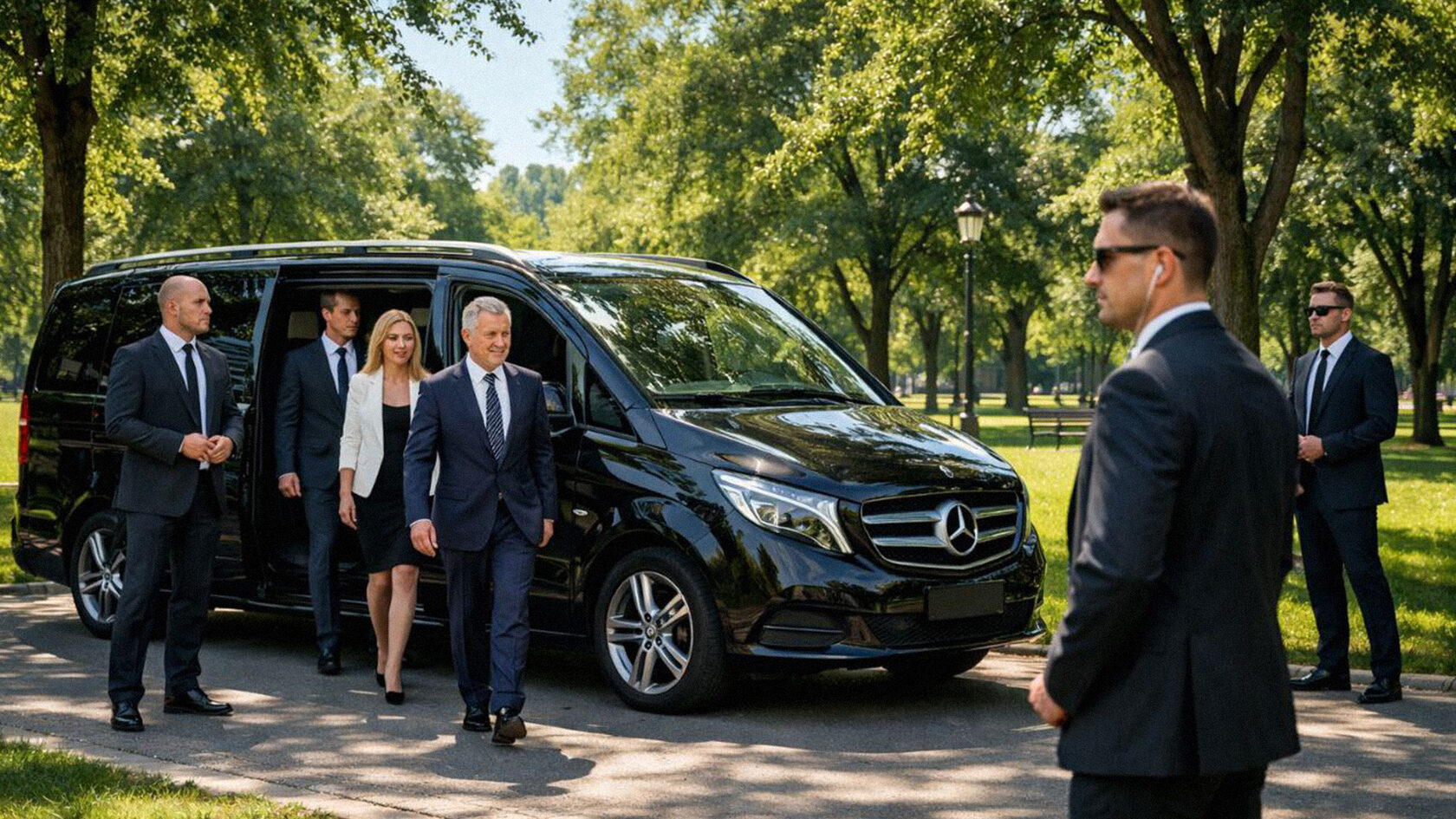
Inside Group and Delegation Protection
In individual protection, much of the design revolves around a single person — their schedule, routes and habits. In group protection the picture changes completely. The focus shifts to a moving system: several key people, dozens of guests, changing locations and different formats within the same day. What looks from the outside like a celebration, a corporate event or a business program, for a professional close protection team becomes a layered operational architecture.
Within the Armada Security framework, group protection is never “just more bodyguards on site.” It is a designed system: clearly defined roles inside the team, pre‑planned perimeter security, real‑time coordination and one core objective — let guests experience the event naturally, while keeping risk under control. To the outside eye, it should look like a well‑organized gathering. Inside, it functions as a seamless, mostly invisible safety network.
From routes to perimeters: building the architecture
The fundamental question behind any group detail sounds simple: “Whom are we protecting, and in what context?” A visiting corporate delegation, a wedding, a company off‑site, a concert — each format reshapes the security design. Yet the underlying sequence remains the same: risk assessment comes first, then route architecture, then the positioning of people.
A delegation of executives usually moves through a chain of locations: airport, hotel, meetings, dinner, perhaps a public appearance. A wedding combines ceremony, reception, guest arrival areas and possible outdoor activities. A concert adds stage, backstage, VIP zones, separate entrances and exits, as well as transport for artists and their teams. At this stage, Armada Security maps the environment: choke points, convergence of guest flows, potential blind spots, and areas that must remain “clean” at all times.
What emerges is essentially a three‑dimensional movement model: who enters where and when, how guest flows intersect with key principals, which zones require hard control and which can operate under a softer, more discreet regime. The number of bodyguards, the way they work and the internal team structure are all built on top of this model.
Roles inside the team: beyond “more people”
When a client says, “We don’t need two bodyguards, we need ten,” professionals do not simply multiply headcount — they change the logic of the operation. Ten individuals acting independently is a recipe for confusion. Ten people functioning as a single system create a reliable protective shell around a delegation or group.
Within that system, roles become crucial. The person responsible for close proximity to the principal operates differently from the one managing an entrance, monitoring corridors or coordinating vehicles. In more complex operations, an advance element goes ahead of the group to inspect venues, check entrances and exits, identify safe rooms and evacuation routes, and liaise with venue staff and organizers.
In practice, part of the team works “in the frame,” walking within a few steps of key figures. Another part maintains the perimeter, controlling approaches, observing crowd dynamics, picking up early signs of trouble. A third layer focuses on coordination, communications, and rapid adaptation when plans shift. To guests and delegates, this manifests as a calm, well‑managed experience: they are welcomed, escorted and shielded from unwanted attention. The complexity remains behind the scenes.
Perimeter protection: building an invisible wall
Perimeter security in group protection is about creating a safe bubble for clients and guests in inherently busy environments. This becomes especially important at weddings, corporate events and concerts, where the line between “inside” and “outside” is often blurred.
From the Armada Security perspective, the perimeter is not just a physical line. It is a blend of visible and invisible layers: managing entrances and exits, shaping guest flows, structuring queues, guiding movement across the venue. On the surface, this may look like professional front‑of‑house teams, polite invitation checks and discreet bodyguards at key vantage points.
Internally, the perimeter is maintained through continuous communication and pre‑defined response patterns. One operator notices suspicious behaviour, another is ready to reposition, a third can quietly close off a corridor or redirect a guest flow, while a safe exit path is kept available for principals at all times. The perimeter expands and contracts as the event unfolds, adjusting to crowd density, emotional energy and the live risk picture.
Real‑time coordination: when seconds override the script
Even the best advance work does not change the reality that live events are fluid. In a delegation, someone stays longer at a meeting, someone decides to greet guests informally, a panel runs late, a private discussion extends into the next slot. At a wedding the emotional tone can shift the schedule on the fly: impromptu speeches, surprise guests, a couple deciding to step outside. At a concert the artist may enter the crowd, fans may surge toward the stage, or weather conditions might suddenly become a factor for an outdoor show.
In such environments, Armada Security’s strength lies as much in real‑time coordination as in planning. Robust communication channels, clearly understood chains of command and well‑defined decision thresholds allow the team to act quickly without improvising from scratch. Tactical decisions, information flow and transport control are separated but tightly synchronized.
This is what distinguishes professional protection from mere “presence.” To the untrained eye, there may be “just people in suits.” For the team, there is a live operational picture: where every principal is, which exits are available, how crowd behaviour is evolving, and how fast the group can be moved to safety if something goes wrong.
Weddings, corporate events, concerts: different rhythms, shared standards
Each type of group assignment comes with its own tempo and emotional landscape, but the core standards stay constant. At a wedding, the priority is to shield the couple and their close circle from unwanted attention and external risks without touching the intimacy and emotional depth of the day. Guests should remember the celebration, not the security operation. The bodyguards’ presence is calibrated so that they can prevent intrusions, manage conflicts or handle uninvited individuals without overshadowing the event itself.
At corporate functions, the lens shifts slightly. Executive teams and key speakers require focused attention, but the broader guest population cannot be ignored. Alcohol, dense networking, sensitive conversations and brand reputation all play a role. The protection team must be ready not only to neutralize physical threats, but also to de‑escalate potential conflicts discreetly and prevent situations that could later damage personal or corporate reputations. Concerts, in turn, add the complexity of fan dynamics, backstage access control, artist transport and multi‑layered venue security.
Across all these scenarios, Armada Security designs group protection so that everyone experiences the event as it was meant to be lived. Guests immerse themselves in the occasion, speakers focus on their message, delegations concentrate on relationships and decisions. The security architecture simply ensures that all of this can happen without avoidable risk.
Group protection as a strategic capability
For owners and top executives, group protection is more than a one‑off service. It is part of a broader risk and continuity strategy: delegations, off‑sites, corporate celebrations, investor meetings and high‑profile launches all contribute to how the organization is perceived and how resilient it is to disruption.
When security at this level is handled professionally, the organization gains a quiet but powerful asset. Events run on time. Key people are protected without being isolated. Guests feel taken care of rather than controlled. No one has to think about “what could go wrong” — not because risks do not exist, but because they are being managed by a team whose work is designed to stay mostly invisible.
This is where the ecosystem mindset of the broader Armada Ecosystem and the operational strength of Armada Security come together: from the first conversation about format and risk, through layered planning and live coordination, to the moment the last guest leaves the venue. For clients, it looks like a successful day or night. For the protection team, it is a mission completed — precisely because nothing happened that would overshadow the event itself.