



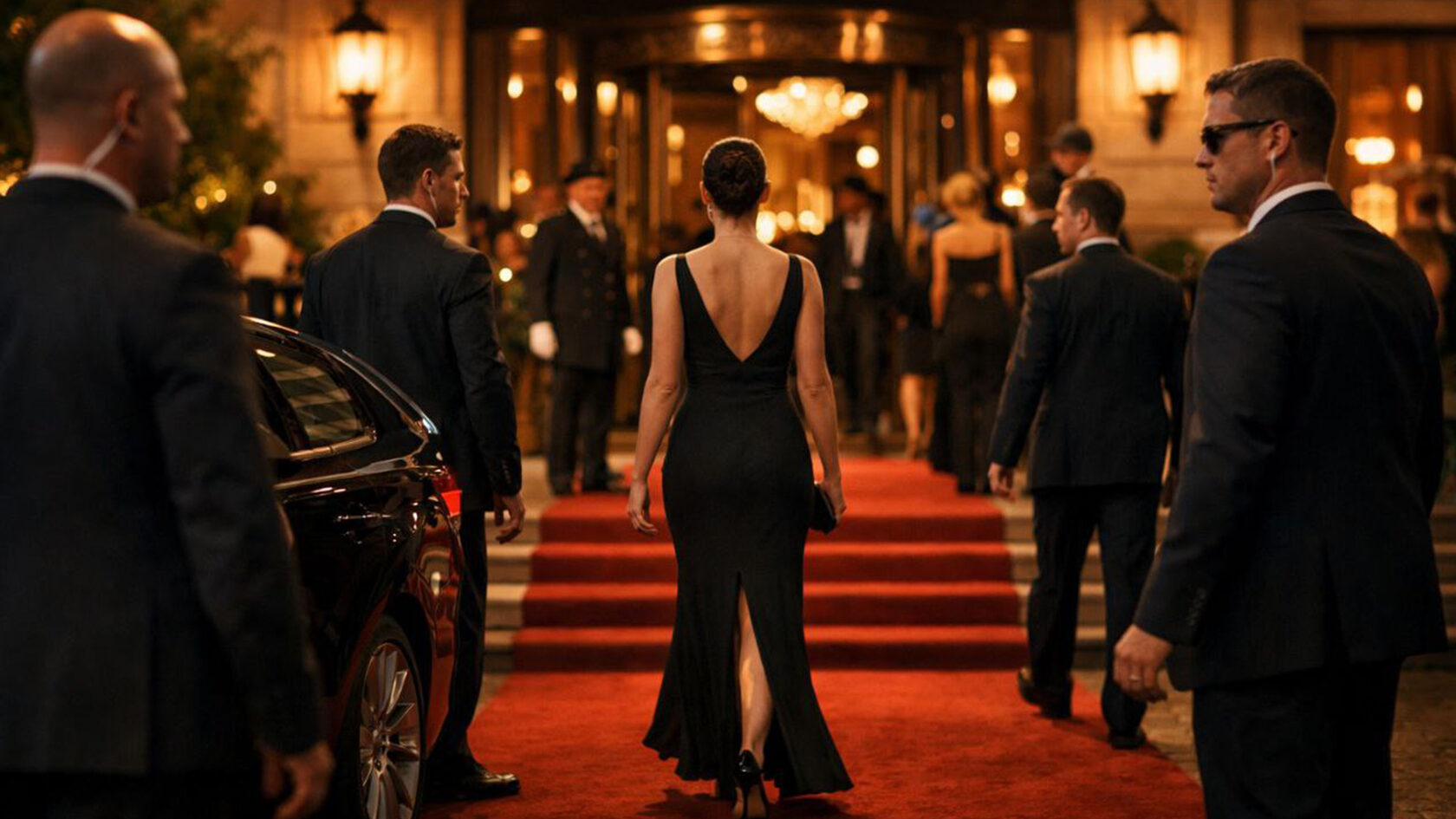
For owners, executives and public figures, personal security is no longer just about “protection from threats.” A bodyguard standing next to you is always part of the picture. Their height, posture, manner of speaking, language skills and social behaviour either reinforce your image — or clash with it. That is why, at Armada Security, matching a bodyguard to a specific client is a separate, standalone service offered for engagements of one month or longer. In contrast, the fast “from 1 hour” service sends you the nearest available professional without a deep casting process — same high standard of training, but optimized for speed, not for fine‑tuned image alignment.
Fast from 1 hour: when time matters more than casting
Let’s start with the base model. If you need protection “right now” — for a few hours, a sudden meeting, an unexpected situation — the Armada Security system works like a smart aggregator: it automatically selects the nearest available bodyguard (with or without a car), dispatches them to you and allows you to track their arrival. You get a vetted and trained professional operating under a unified standard of quality, but without a customized match to your height, look or language profile.
This is an intentional choice: for short‑notice, short‑term tasks, priority goes to response time and a reliable baseline of competence, not to deep image matching. It’s ideal for “today problems”: domestic conflicts, last‑minute trips, sudden need for escort when the main thing is to have a trustworthy professional at your side quickly.
Long‑term engagements: matching as a dedicated service
When you book protection for a month or longer, the dynamics change. The bodyguard becomes part of your daily life: they appear in photos, attend meetings, are visible to partners, family and staff. In these cases, Armada Security offers a separate casting service to match a bodyguard to your personal image and lifestyle.
The key point: casting is not automatically included with every booking; it is a distinct service available for longer‑term protection. We invest time and expertise into selecting a person who becomes an organic extension of your presence, not just “someone with training” next to you.
The database: who you are determines who should stand beside you
The foundation of this process is a structured database of protectors. It is more than a list of names — it is a living system with photos, profiles and parameters that matter specifically to high‑level clients:
- height and physique;
- general appearance and style;
- language skills (English and other languages as required);
- experience in corporate, cultural and family environments;
- social etiquette and comfort in high‑society settings.
Each profile is not only facts on paper, but also an assessment of how well the specialist integrates into different social environments — from private business clubs to diplomatic receptions. For clients who constantly move between business, politics and culture, this is crucial.
Questionnaire and interview: understanding you before we choose for you
Matching starts not with the database, but with you. For long‑term engagements, you complete a detailed questionnaire and speak with a security manager. The questions go far beyond “where do you live and where do you go.”
We clarify:
- the contexts in which you appear most often (boardrooms, conferences, private dinners, family events, cultural functions);
- how you would describe your own style — from strictly corporate to creative and eclectic;
- how open or reserved you want to appear in public;
- which languages and cultural codes dominate your environment (Russian business, international partners, creative industries, etc.).
From this, we build a profile: not “any bodyguard,” but a portrait of the person who should be beside you — in terms of height, appearance, communication style, languages and behaviour.
Height, appearance and movement: how your protective “frame” looks
Height and appearance are not about vanity; they are about visual harmony. A massive protector next to a smaller, agile client can look disproportionate. A much smaller bodyguard next to a physically imposing client can be perceived as a weak link by those watching.
In casting, we consider:
- relative height (the protective frame should look confident without overshadowing you);
- build and movement (bodyguards need to move with quiet confidence, not like an action‑movie stereotype);
- overall appearance (more rugged, more intellectual, very neutral, more “corporate” or more “athletic,” depending on your world).
Next to a politician, one style may be right; next to an artist, another; next to a tech founder, something different again. Our aim is to balance visual authority with your personal style.
Languages and cultural fluency: protection that understands the room
For clients whose lives are international, language is more than a convenience; it is a security tool. English is often a must — to interact with partners, understand what’s happening around you and coordinate with foreign teams and staff.
But it goes beyond language. A matched bodyguard should:
- understand protocol and how to behave at international forums, award ceremonies and formal events;
- read the “language” of your industry — recognising the difference between an investor, a journalist, a government official or an artist;
- communicate appropriately with foreign assistants, drivers and venue personnel.
That does not turn the protector into a PA, but it makes them part of the environment rather than a visual contradiction to it.
Etiquette and social environments: where tone matters more than force
Another core layer is etiquette in high‑society and business environments. A strong bodyguard next to a high‑status client must know more than tactical drills. They must understand how to stand, where to look, when to step forward and when to fade into the background.
We pay attention to:
- maintaining composure and dignity under cameras, media attention and social pressure;
- appropriate behaviour when high‑ranking guests arrive — knowing when to greet and when to simply step aside;
- polite, non‑confrontational handling of staff and guests — the bodyguard must never be the source of rudeness or drama.
In social settings, the protector is part of the “staging.” Their role is to sustain a sense of order and status without stealing the scene.
Casting vs. speed: two tools for two different tasks
It is important to maintain a clear distinction between the two operating modes:
- fast from 1 hour — you receive the nearest available, fully trained and vetted bodyguard from Armada Security within about an hour. No casting, maximum speed;
- image‑matched selection as a separate service — for bookings from one month and longer. Here we invest time in questionnaires, interviews, database analysis, shortlists and, if needed, in‑person introductions.
Neither is “better” in the abstract; they serve different purposes. The first is about urgency and a robust baseline. The second is about nuance and long‑term compatibility.
The outcome: a bodyguard who feels “yours” from day one
When the casting process is complete, you don’t just receive “a bodyguard for a month.” You meet a specific person whose parameters, appearance and behaviour have already been tuned to your profile. Often, we arrange an initial meeting so you can see how this person looks next to you, how they move, how they respond to typical scenarios.
From there, the relationship evolves:
- the bodyguard adapts to your schedule, routes and preferences;
- the security team refines details: where closer presence is needed, where more distance is appropriate;
- if we see that the chemistry or working style is not right, we can re‑match and adjust.
Ideally, over time, you stop seeing the bodyguard as a separate element. They become a natural part of your daily scene — quiet, attentive and visually aligned with who you are.