




How personal protection helps you get through separation without threats or humiliation
By 2026, divorce is statistically normal but still feels like a personal disaster for the people going through it. The more shared assets, children, and emotions are involved, the higher the chance that things will spill over the edges of courts and law offices. Arguments move to the parking lot, doorsteps, and playgrounds; pressure shows up as stalking, shouting, grabbing, or “accidental” encounters.
In those moments, personal protection is not about “escalating the conflict”. It is about ensuring that the hardest days pass without physical coercion and public humiliation.
Where lawyers and mediators cannot follow
Lawyers and mediators are essential, but their work has limits:
- they do not stand with you in front of your building;
- they are not in the elevator when emotions spike;
- they cannot intervene when your ex or their entourage blocks your way or grabs your arm.
The most dangerous gaps typically appear here:
- waiting at home, work, or the children’s school to “have a serious talk”;
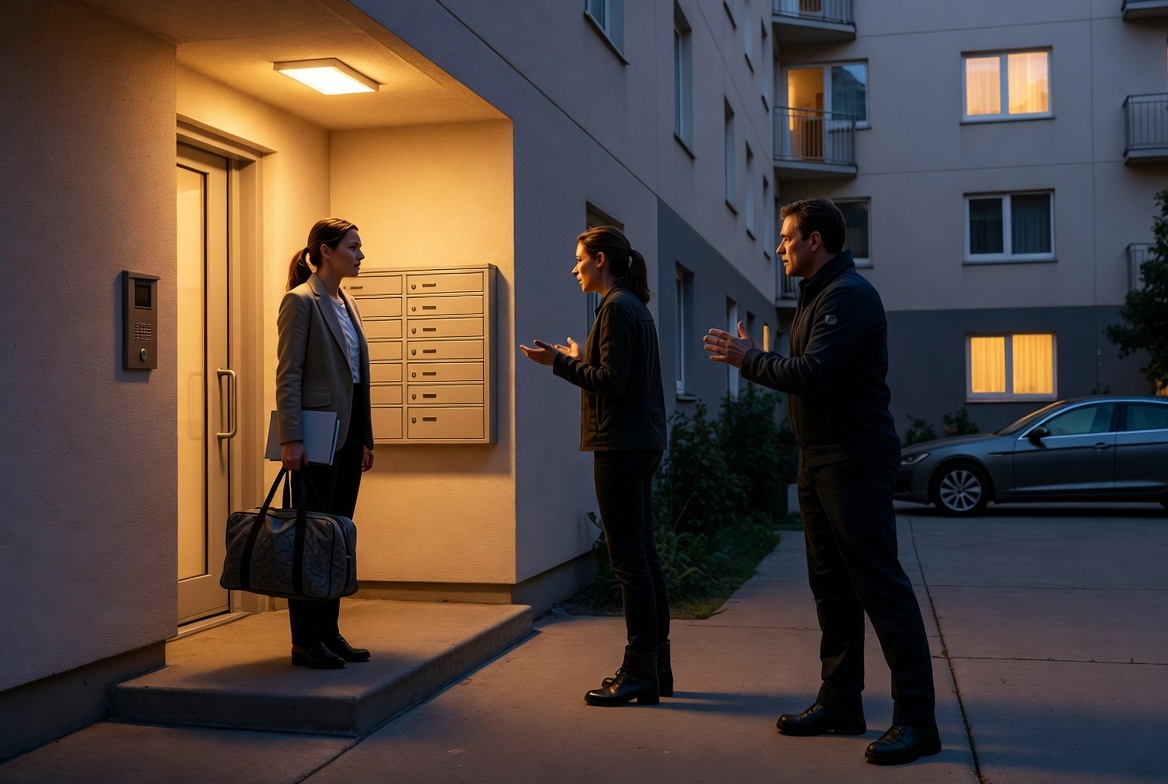
- confrontations in the entrance hall, parking lot, or stairwell;
- vandalism against property — scratched cars, damaged doors, thrown objects;
- sudden appearances framed as “I have a right to be here, this is my house/my yard/my kids”.
At that point you need someone who works with space and behavior, not just documents — a professional bodyguard.
The bodyguard’s role in high‑conflict separation
Specialized “divorce protection” services are now a standard offering in many security firms, and that is not a coincidence. In this context, a bodyguard is not a “fighter on your side”, but a specialist in preventing escalation.
Their responsibilities typically include:
- Planning routes and contact points. How you enter and leave your building, where you park, how you access the court or child welfare office.
- Controlling distance. Preventing your ex or their associates from cornering you, blocking exits, grabbing you, or staging scenes in front of neighbors or children.
- Being present at key meetings. Court hearings, notary appointments, handovers of children, visits to shared property.
- Documenting threats and pressure. Helping to capture evidence of real threats and attempts at violence that courts often otherwise dismiss as “words”.
- Emergency extraction. Quickly and calmly removing you (and children) from situations that spin out of control.
The goal is not to “punish” anyone. It is to get you through the conflict with your dignity, safety, and legal position intact.
How Армада Безопасность structures protection in divorce
Армада Безопасность works both with short, critical episodes and with longer periods of tension. This matters because divorces tend to move in phases — from calm to explosive.
What the service offers:
- On‑demand bodyguards from 1 hour. You can bring protection in for specific days: hearings, child exchanges, visits to shared property.
- Long‑term coverage. For drawn‑out, high‑conflict cases, it is possible to build a continuous or rotating protection schedule.
- Security cards and packages. Prepaid cards and bundles keep protection ready to activate, without renegotiating terms every time — useful when you know the process will be long.
- Coordination with legal strategy. Bodyguards align with your lawyers and mediators: they appear where physical risk is highest, while legal professionals handle the courtroom and paperwork.
You decide where you most need that layer of support — at home, in court, during handovers, or in interactions with your ex.
Avoiding the trap of weaponizing security
One real danger is turning the bodyguard into a prop in the conflict — “Look, I have protection, I’m stronger than you”. That only raises the stakes.
A more mature approach is to treat security as structure, not a weapon:
- do not drag the bodyguard into verbal fights;
- do not provoke your ex while “hiding” behind security;
- do not use their presence to manipulate children (“See, dad/mom is dangerous, that’s why I need a bodyguard”).
Within Армада’s philosophy, the bodyguard is part of an adult position: you refuse to play by the rules of intimidation and instead set a clear boundary — this conflict will stay within legal and psychological limits, not spill into the street.
When to seriously consider personal protection in divorce
Not every separation requires a bodyguard. But it is wise to consider it when:
- there have already been direct or indirect threats;
- your ex or their circle has shown up uninvited at home, work, or school;
- there have been incidents of physical pressure, grabbing, blocking movement;
- children, parents, or neighbors are being pulled into confrontations;
- you find yourself anxious about specific places and times of day.
At that point, security is not “overdoing it”. It is a way to prevent a civil dispute from turning into a criminal case or a trauma.
Армада Безопасность offers the option to move through this phase as quietly on the outside and as safely on the inside as possible — so that your divorce remains on paper and in court, not in bruises and viral videos from the courtyard.