




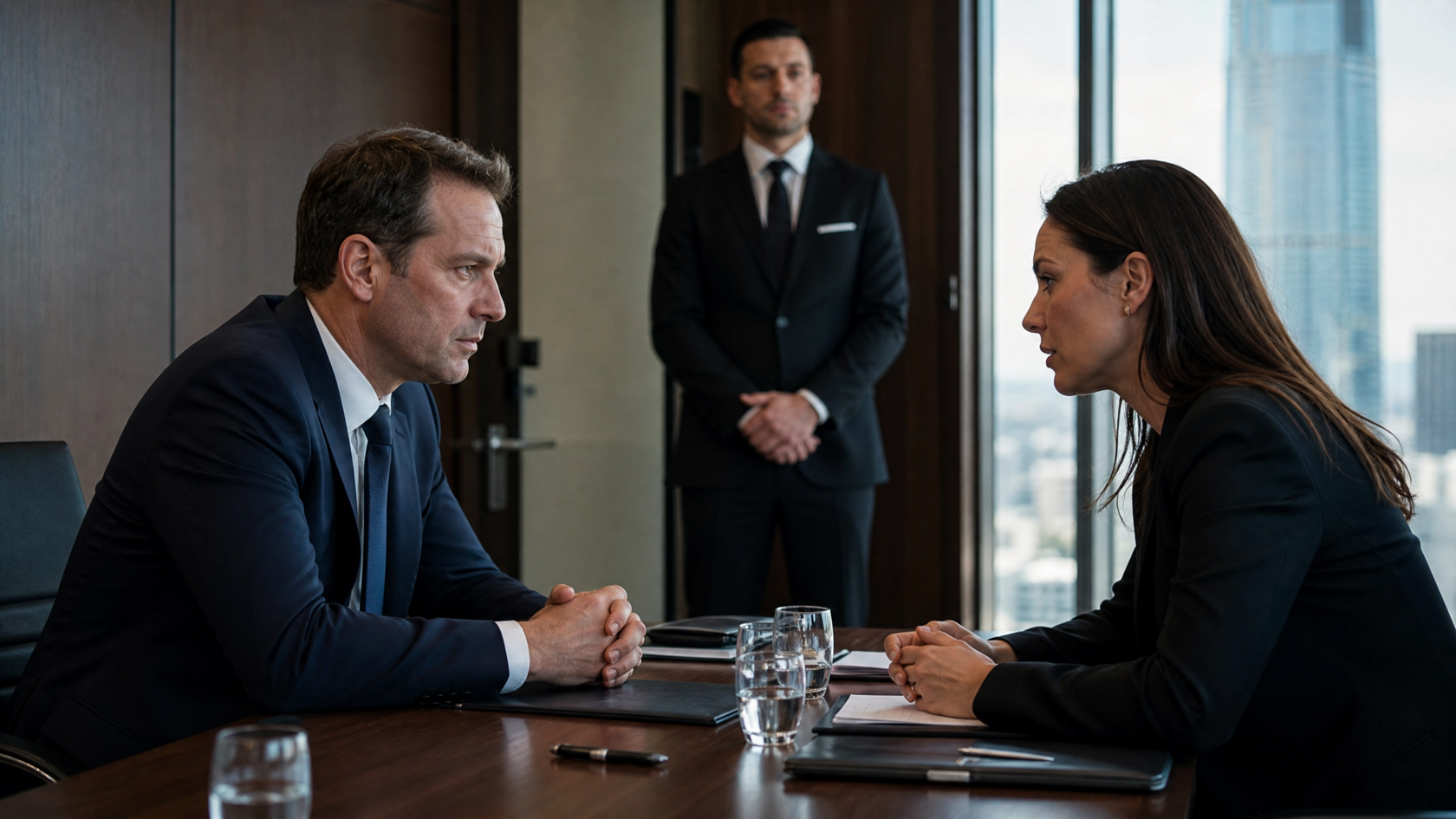
Why a bodyguard in high‑stakes negotiations is not a “muscle flex” but a tool that keeps the focus on the deal, not the threats
Negotiations are far more than “a meeting where people talk.” They are the arena where deals are made or broken, conflicts are resolved or escalated, partnerships are born or die. In this arena, what is at stake is not only the physical safety of the person at the table, but also the strength of their position. When an owner, CEO, or key representative comes to the negotiating table, they are not just discussing numbers. They are defending what truly matters to them and to the system behind them. In this context, personal security during negotiations is not about “showing off power.” It is about creating conditions where the person can stay fully focused on substance instead of scanning for danger around the room.
Why negotiations are a genuine risk zone
Negotiations are not only about “terms and conditions.” They are a pressure cooker. Emotions, money, reputations, and sometimes entire companies are on the line. This makes the environment inherently volatile and, at times, dangerous.
1. Emotional pressure that pushes people over the edge
High‑stakes talks almost always generate tension. People are unhappy with terms, outcomes, or behavior of the other side. Under pressure, some start crossing lines: raising their voices, using threats, behaving aggressively, trying to intimidate or corner the counterpart.
In that moment, the principal is often left alone with this pressure. They do not want to “look weak,” back down, or admit that the situation has become unsafe. As a result, they may stay in a room and in a format that is no longer acceptable either for their safety, or for the integrity of the process.
2. Attempts to use physical presence as leverage
Sometimes, people come to negotiations not only with lawyers, but with their own “entourage.” That entourage may be used as a form of pressure: looming in the hallway, standing too close, entering the room uninvited, making it clear “who’s in charge here.”
From the outside it can look like “just people in the background,” but for the principal this can quickly turn into a situation where they are being forced to choose between their security and their willingness to keep talking. Without professional protection, it is very easy to miss the moment when the situation quietly shifts from tough bargaining into intimidation.
3. Conflict that shifts outside the meeting room
Not all problems stay at the table. A heated meeting can spill into the corridor, the parking lot, the lobby of the building, or even follow the principal home. People may start waiting at the exit, filming on phones, shouting, trying to “catch” the person outside the formal setting.
From the principal’s perspective, all this looks like “unpleasant, but manageable.” In reality, it is the point where reputational, physical, and psychological risks intertwine — and where a structured security approach becomes critical.
How a bodyguard protects not just the person, but their negotiating position
A bodyguard in negotiations is not there as a “human argument.” If that is how they are being used, something has already gone wrong. A professional close‑protection officer is there to keep the principal safe, calm, and mentally free to negotiate — instead of forcing them to think about exits, threats, or who is standing behind their back.
1. The bodyguard as a risk manager, not just a shield
A good protector is not just “someone standing nearby.” They are a risk manager with a security mindset. Before the meeting, they look at the venue, arrival and departure routes, the composition of both delegations, and past conflict history. During the meeting, they quietly monitor the room and its dynamics: who is getting agitated, who moves closer than necessary, who suddenly appears in the corridor.
In this sense, the bodyguard is not just about “physical defense.” They are part of the decision‑support system: they give the principal the right to stay fully immersed in the negotiation, knowing that someone else is watching the environment and thinking in scenarios.
2. The bodyguard as part of the deal team
When personal protection is integrated properly, the bodyguard is not an alien element in a suit by the door. They are part of the workflow. They know who the key people are, how long the meeting is planned to last, what the “red lines” are in terms of safety and format.
Because of this, they do not derail the day with sudden demands; instead, they help keep it on track. If the temperature in the room gets too high, they can quietly signal that it is time for a break, to move to a different room, or to end the meeting altogether. The principal does not have to improvise alone; there is a pre‑agreed protocol that everyone understands.
3. The bodyguard as a trust signal, not a threat
When a security setup is professional and discreet, it actually increases trust. Partners see that the person takes risk management seriously. The internal team sees that leadership protects not only assets, but also people. Investors understand that high‑stakes situations are handled with structure rather than bravado.
In this sense, a bodyguard is not a symbol of paranoia. It is a sign of maturity and of a long‑term view: “We intend to negotiate seriously, and we intend to do it safely.”
Why security is often missing from negotiations
Despite all this, many leaders still come to difficult talks without any personal protection at all. There are a few recurring reasons.
1. “I’m not that big, I don’t need it”
This is a common misconception. People think protection is only for billionaires, politicians, or celebrities. In reality, risk is driven by conflict intensity and stakes, not only by net worth.
If the outcome of the meeting can significantly impact livelihoods, reputations, or large sums of money, the negotiation is already in the risk zone — regardless of whether the principal is on the Forbes list or not.
2. “I can handle myself”
This is the “hero myth.” Many owners and executives are used to relying on themselves. They are confident, experienced, and can read people well. But no amount of personal courage can replace a second pair of trained eyes and a prepared exit plan.
You cannot, at the same time, hold the strategic line in a tough discussion and fully monitor everyone’s behavior, body language, and movements around you. Trying to do both inevitably weakens either your safety, or your negotiating performance — and often both.
3. “It’s too expensive for a couple of meetings”
From the outside, security looks like a cost with no direct ROI. But in reality, it is insurance on the most valuable asset: the person who carries the deal in their head, their network, and their signature. The financial and reputational cost of one serious incident is almost always far higher than the cost of proper protection for a series of key meetings.
4. “It will make me look weak”
Another dangerous misconception: that arriving with security somehow diminishes authority. In practice, among people who regularly operate at high stakes, it is usually the opposite. Having professional protection signals that the person understands the realities of risk and is not playing with their life or their company’s future for the sake of optics.
Weakness is pretending there is no risk when everyone in the room can feel that there is.
Choosing the right protection setup for negotiations
Selecting protection for negotiations is not about “hiring the biggest guy in the room.” It is about choosing the security configuration that fits the context and culture of the deal.
1. Clarify the specific risks
First, it helps to be honest about what worries you. Is it emotional volatility and tempers flaring? The other side’s reputation for using pressure tactics? Previous threats? The possibility of protests or ambushes outside the venue?
The clearer the risk picture, the more precisely the protection team can tailor their approach and protocols.
2. Define the format
Negotiations can range from a one‑off meeting in a hotel lobby to a series of closed‑door sessions over weeks. The security format should match that:
- a one‑time high‑risk meeting may call for a focused, hourly protection setup;
- multi‑day talks might require a combination of residential, transport, and venue security;
- public negotiations or signing ceremonies can need additional perimeter and crowd‑management measures.
3. Decide on the “visibility level”
Not every culture or context reacts the same way to visible security. Sometimes a low‑profile, almost invisible presence is ideal. In other situations, a clearly identifiable but calm and professional bodyguard can be helpful, subtly discouraging attempts at pressure.
The key is to align the visibility level with your strategic intent: to support the process, not overshadow it.
4. Align on the bodyguard’s role at the table
Finally, you need clarity on what exactly the protector does during the negotiation:
- Are they staying outside the room but within immediate reach?
- Are they inside, quietly observing from the wall?
- Are they also responsible for managing access to the room and controlling who comes and goes?
Agreeing on this in advance with both your team and the protection professionals removes ambiguity and awkwardness on the day of the meeting.
What a principal really gains from protection in negotiations
When a leader comes to the table with properly organized personal security, they receive far more than “someone who can intervene if things go bad.”
They gain:
- mental bandwidth to think clearly about arguments, numbers, and scenarios instead of scanning for danger;
- emotional stability because a part of the background anxiety is removed;
- freedom of choice — it becomes easier to say “no,” walk away, or take a break when safety is not a question mark;
- credibility in the eyes of partners, team, and investors as someone who manages risk, not denies it;
- continuity — even if a meeting becomes too toxic or risky, the person leaves intact and can decide on next steps from a safe distance.
In this sense, a bodyguard at negotiations is not about fear. It is about freedom: the freedom to negotiate hard, but not recklessly; to defend your position without putting your life, your family, or your company on the line.
When you bring personal protection into high‑stakes negotiations, you are not “coming with muscle.” You are bringing structure into a space that often thrives on chaos and pressure. You are choosing to think about the deal itself, not about how to reach the exit if something goes wrong.
You are turning the negotiating room back into what it should be — a place for decisions, not a stage for intimidation. And that, in the long run, protects not only your body, but also your position, your reputation, and the system that stands behind you.